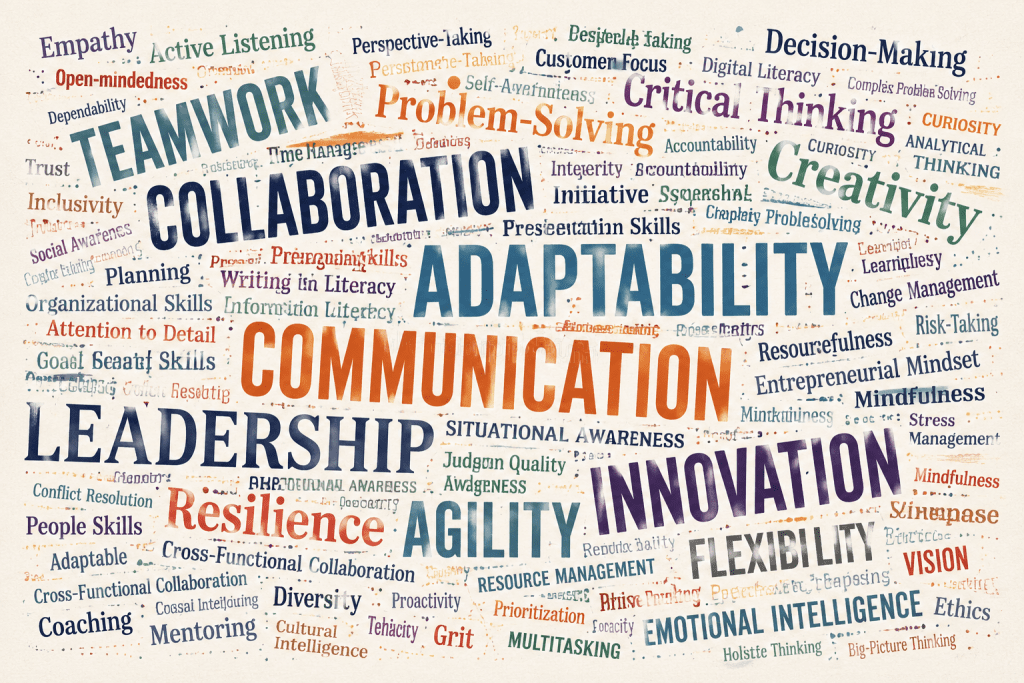
The shift toward a knowledge-based economy has changed what employers value most: instead of technical qualifications that may become obsolete, organizations now seek adaptive and transferable non-technical skills. Despite their popularity, there is no global consensus on how to define or measure these abilities. Instead, the sheer volume of research on these skills has created […]
The contemporary business environment presents CEOs with complex, interconnected challenges, where attracting and retaining top talent and navigating slowing economic growth are the top executive concerns. According to a survey of 223 CEOs, attracting and retaining talent is the primary concern for more than half (54%), followed closely by global recession/slowing economic growth (52%). These […]
The Global Leadership Forecast 2025, representing DDI’s eleventh forecast in 24 years, synthesizes responses from 2,185 human resource professionals and 10,796 leaders across 2,014 organizations worldwide. This extensive research, spanning more than 50 countries and 24 major industry sectors, examines talent and leadership issues and best practices amidst a challenging environment. The introduction notes that […]
Periods of heightened stress and uncertainty, such as political turmoil, economic instability, and global crises, tend to erode individuals’ general perceived control, defined as the belief that success at work is in their hands. Perceived control depends on the locus of control (whether outcomes are determined by internal or external factors) and self-efficacy (the belief […]
The traditional approach to workforce differentiation is talent management, which involves disproportionately investing in a small, exclusive group of high-value employees, often referred to as “talents”. However, there’s been increasing pressure for organizations to adopt more inclusive talent management differentiation practices i.e., including a larger number of employees in the pool of high-value talents. For […]
Compressed work schedules, such as full-time, 4-day weeks, are viewed as solutions for enhancing work-life balance and increasing full-time female labour participation. A Ghent University study shows that many employees can find the compressed schedules appealing but not for the expected reasons. These findings emerged from the study’s focus on how autonomy, career, and personal […]
In addition to traditional static, job-oriented, high-performer talent management initiatives and programs, companies should approach talent management through a skills-matching perspective focused on aligning individual skills with organizational goals and strategies. A study based on in-depth interviews with 34 senior HR leaders from eight countries including Singapore, China, the United States and several European countries […]
Middle managers play a key role in implementing the talent management programs of an organization, as they are instrumental in identifying high-potential individuals and supporting the development of their knowledge and skills. Any talent management role is complicated, however, by the position of middle managers as a bridge between the strategic-oriented top leadership and the […]
There is a consensus that breaks during working hours can help employees recover from the stress and fatigue of work and thus improve their well-being and performance. A team of Canada-based scholars empirically tested this assumption by reviewing the full range of research in this area, pulling from multiple disciplines. The scope of their review […]
A study by Ormonde Cragun of the University of Minnesota Duluth and Michael Ulrich of Utah State University applies the principles of “Dynamic Capabilities” to succession planning to create a blueprint for strategy-driven human resources management. Succession planning is the coordinated effort of organizations to avoid disruptions when key people leave by developing potential candidates […]